
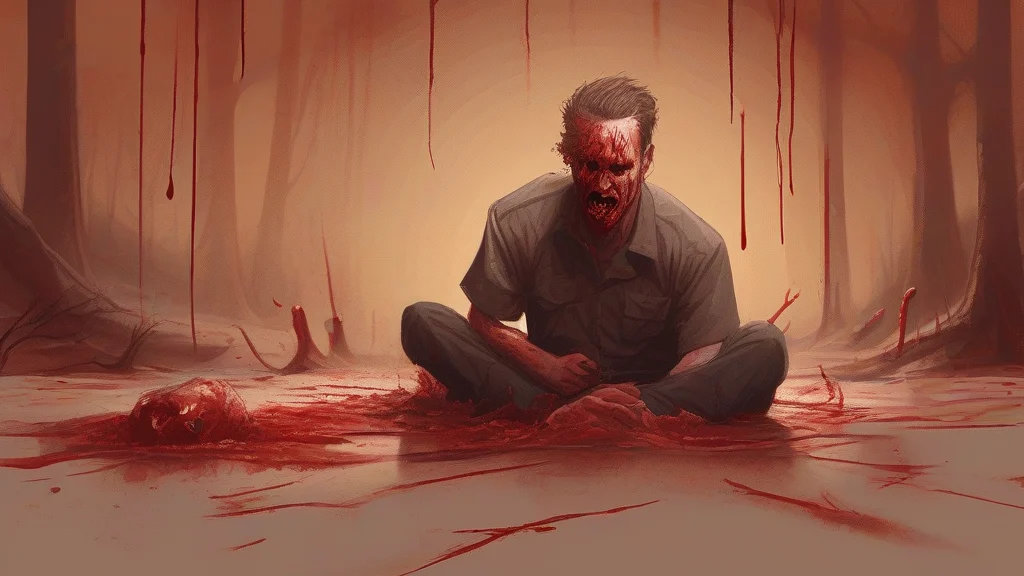
What does gore mean?
Gore most commonly refers to the blood shed during a violent or gruesome injury. The word has a forceful, memorable quality because it directly names the physical consequence of an injury without softening it, although some speakers consider the term graphic. As a verb, gore describes being pierced or wounded by a horn, tusk, or sharp object, as when an animal gores a person. The word is especially associated with descriptions of violence, horror, accidents, and warfare, and it can evoke imagery that is blunt and immediate. Less commonly, gore is a technical noun for one of the triangular fabric panels from which a sail or garment may be constructed. Its value as a vocabulary word lies in this combination of vivid violent meaning and a more specialized sailmaking sense. The related adjective gory is also common, especially in expressions such as a gory scene or a gory story.
Blood shed from a violent or gruesome wound; a bloody injury; or, in technical usage, a triangular panel of fabric used in a sail or garment.
"The road was covered with gore after the collision."
The blood-related sense is often graphic and vivid, while the fabric-panel sense is chiefly technical.
To pierce or wound someone with a horn, tusk, or sharp object, causing blood to flow.
"The charging bull gored the handler."
This is a literary and strongly violent verb, commonly used with animals or dangerous pointed objects.
The plural is uncommon in the blood-related sense but is standard in technical descriptions of sails or garments divided into triangular panels.
"The sailmaker joined the gores with carefully stitched seams."
Gore has a double life: it can describe the blood from a violent wound or the triangular panel that helps form a sail.
Reviewed by Deb Chak, Editor. AI-assisted content curated by RJS Tech Solutions LLP.
Etymology of gore
The blood-related word descends from Old English gōr, meaning “blood,” and continued through Middle English as gore. The verb developed from the older noun, with the sense of piercing or wounding so as to produce blood. The related English adjective gory was formed from the same word, while the separate technical sense for a triangular fabric panel arose as a later development of the term.
Related word forms
How gore is actually used
The noun is strongly associated with violence, horror, and graphic description, but it can also appear in journalistic, literary, or medical contexts. The verb is literary and usually describes a violent injury caused by an animal or pointed weapon. The fabric-panel sense belongs chiefly to technical, nautical, sewing, and garment-making vocabulary.
Easily confused with gore
Gore is a noun naming shed blood or a bloody injury, whereas gory is chiefly an adjective meaning covered in or characterized by blood.