
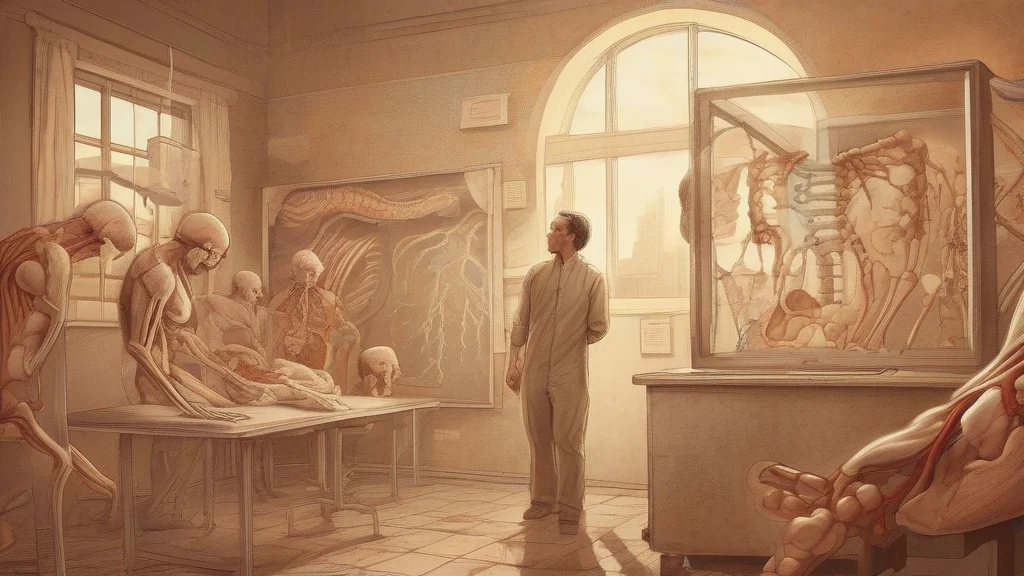
What does anatomy mean?
Anatomy is the branch of biological science devoted to studying the structure of living things — the shapes, positions, and relationships of organs, bones, muscles, tissues, and cells in humans, animals, and plants. Traditionally learned through dissection, it remains foundational to medicine, surgery, veterinary science, and art, where accurate depiction of the body depends on anatomical knowledge. Beyond biology, the word is used figuratively to describe the underlying structure or essential components of almost anything: writers may speak of 'the anatomy of a crisis' or 'the anatomy of a deal' to mean a careful breakdown of how something is put together. The term carries connotations of rigor, precision, and systematic inquiry, and it pairs naturally with physiology, its functional counterpart. Derived forms such as 'anatomical,' 'anatomist,' and 'anatomize' extend its reach across scholarly and everyday language alike.
The scientific study of the bodily structure of living organisms, particularly as revealed by dissection.
"Her expertise in comparative anatomy made her a leading voice in evolutionary biology."
Often subdivided into gross anatomy (structures visible to the naked eye) and microscopic anatomy (histology and cytology).
The structural composition of a particular organism, body part, or, by extension, any complex entity.
"The documentary examines the anatomy of a corporate collapse."
The plural is rare and typically refers to multiple anatomical systems or to different organisms' anatomies being compared.
"The textbook compares the anatomies of vertebrates and invertebrates side by side."
For nearly two thousand years, doctors trusted anatomical drawings based on animal dissection — until the 16th century, when Andreas Vesalius dared to dissect actual human bodies and rewrote the entire map of medicine.
Reviewed by Deb Chak, Editor. AI-assisted content curated by RJS Tech Solutions LLP.
Etymology of anatomy
Anatomy derives from the Greek 'anatome,' meaning 'dissection,' formed from 'ana-' ('up' or 'throughout') and 'temnein' ('to cut'). The word entered Latin as 'anatomia' and passed into European languages during the Renaissance, when human dissection revived as a medical practice. English adopted it in the late Middle Ages or early modern period, and it has cognates such as French 'anatomie' and Italian 'anatomia.' Related English derivatives include 'anatomist,' 'anatomical,' and 'anatomize.'
Related word forms
How anatomy is actually used
In figurative use, 'anatomy' often appears in phrases like 'the anatomy of a scandal,' implying a systematic breakdown of a topic. The word is standard in both formal academic writing and everyday speech; no significant regional variation exists between British and American usage.
Easily confused with anatomy
Anatomy studies the structure of organisms and their parts, while physiology studies how those structures function.