
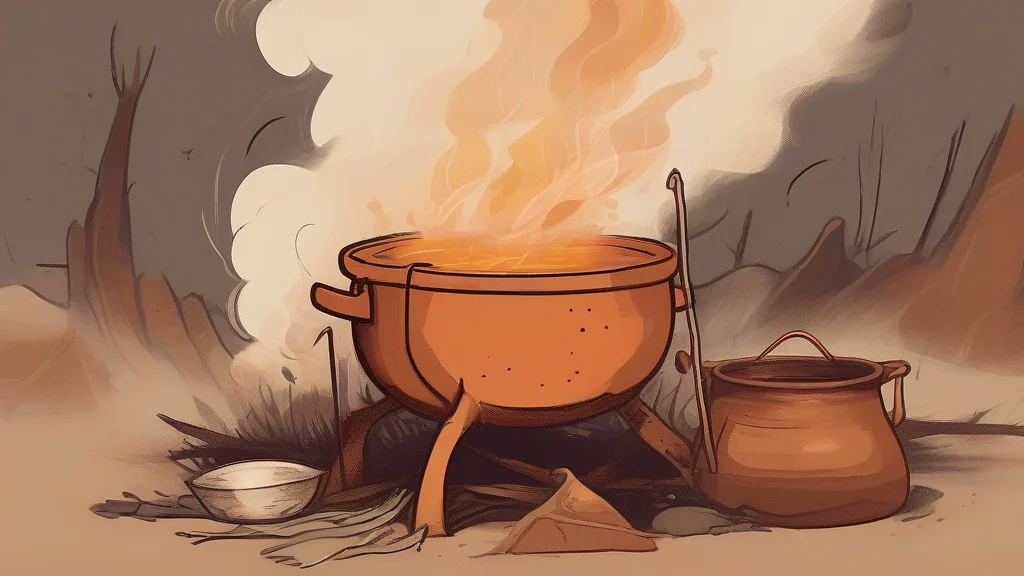
What does cauldron mean?
A cauldron is a large, round-bottomed cooking pot, traditionally made of cast iron and suspended over an open fire by a handle or chain. Once a staple of household kitchens for boiling stews, soups, and laundry water, the cauldron has largely passed out of everyday domestic use and now carries strong associations with the medieval past, folklore, and particularly the image of the witch brewing potions over a flame. Because of this vivid imagery, the word thrives in literature, fantasy fiction, and idiomatic speech. It also functions powerfully in figurative language: a region may be described as a 'cauldron of unrest', or a crowd as a 'seething cauldron', conveying turbulent, bubbling intensity. Derived from the Latin root for heat, the word shares ancestry with culinary terms like chowder, making it as rich in history as it is evocative in modern usage.
A large, deep pot used for boiling liquids or cooking over an open fire.
"An enormous iron cauldron hung above the hearth, filled to the brim with broth."
(Figurative) A situation or place marked by intense, turbulent, or seething activity.
"The debate turned into a cauldron of conflicting ideologies."
Regular plural formation; commonly used when referring to multiple pots or metaphorically to several turbulent situations.
"The medieval kitchens were lined with great cauldrons, each bubbling over a separate fire."
The word 'cauldron' and the soup 'chowder' are distant cousins — both trace back to Latin 'calidus', meaning hot.
Reviewed by Deb Chak, Editor. AI-assisted content curated by RJS Tech Solutions LLP.
Etymology of cauldron
Cauldron derives from Middle English 'caudron', borrowed from Anglo-Norman, which itself came from Late Latin 'caldario', from Latin 'calidus' meaning hot. It is thus related to words like 'chowder' and 'caldera', all stemming from the same Latin root for warmth or heat. The spelling with the intrusive '-l-' became standard by around the early 17th century.
How cauldron is actually used
Most common today in historical, fantasy, literary, or figurative contexts rather than literal kitchen use. The plural is regular ('cauldrons'). Often evokes witches, medieval cooking, or dramatic imagery. In figurative use it typically follows 'a' and takes an 'of' phrase describing what seethes within.
Easily confused with cauldron
A chaldron is an obsolete English unit of dry measure for coal, whereas a cauldron is a large cooking pot.