
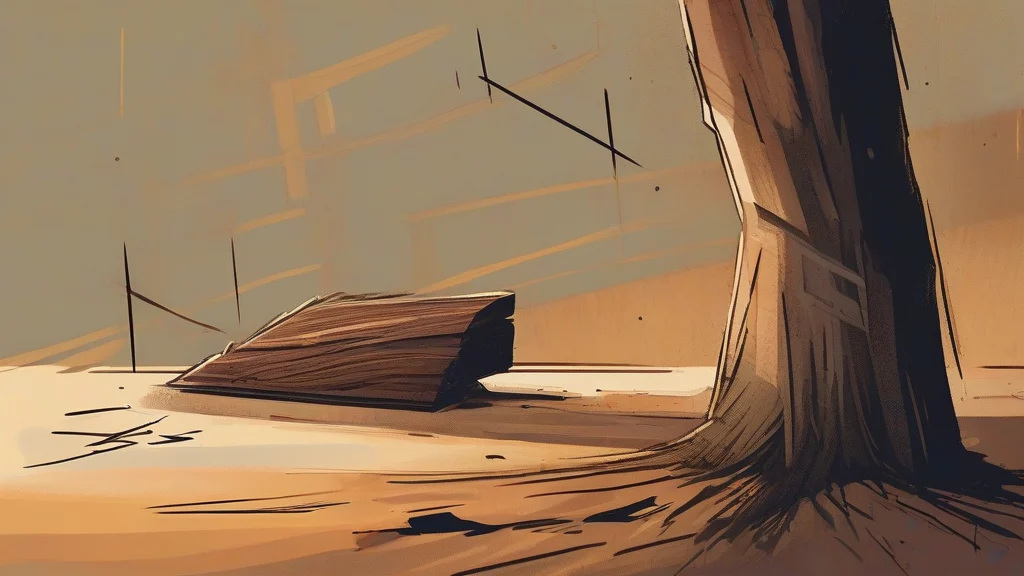
What does splinter mean?
A splinter is a small, sharp fragment, most often of wood, but also of stone, glass, or similar materials. The word is vivid because it conveys both the physical process of something hard breaking apart and the sudden, sometimes dangerous, sharpness of the resulting fragment. A splinter can also be figurative: a political or organizational splinter is a group that breaks away from a larger body. As a verb, splinter describes wood, glass, or other material splitting into pieces, and can similarly describe an organization dividing into factions. In British and American English, the word is common in everyday speech and formal reporting alike. Its usefulness lies in its strong visual association: it captures not merely division, but division that leaves distinct, often pointed pieces.
A small, sharp fragment broken from wood, stone, glass, or another hard material; also, figuratively, a small group that has separated from a larger organization.
"A splinter of wood remained embedded in the table."
The figurative sense is common in discussions of politics, religions, and organizations, where a splinter group has broken away from the main body.
To break or cause to break into sharp fragments; figuratively, to divide into separate groups or factions.
"The glass splintered under the impact."
The verb can be transitive, as in “the impact splintered the window,” or intransitive, as in “the organization splintered after the dispute.”
The regular plural is splinters, as in “splinters of wood” and “political splinters.”
"Tiny splitters—"
From a tiny fragment of wood to a political faction, a splinter is a vivid word for something that has broken away from a whole.
Reviewed by Deb Chak, Editor. AI-assisted content curated by RJS Tech Solutions LLP.
Etymology of splinter
The word entered Middle English in forms related to splinten, an older verb meaning to split or cleave. It derives from a Germanic root associated with splitting and is related to English split and splint. Its Germanic relatives include Dutch splinters and German Splitter, both meaning a fragment or shard. The modern noun and verb senses developed from this older language of splitting and breaking apart.
Related word forms
How splinter is actually used
The noun is common in literal descriptions of wood and other hard materials, while the figurative sense is especially common in political and organizational contexts. The verb is used both transitively and intransitively; in figurative use, it usually suggests separation into competing groups rather than complete destruction.
Easily confused with splinter
A splinter is a small sharp fragment broken from a material, whereas a splint is a strip or piece used to support or protect something, such as an injured finger.