
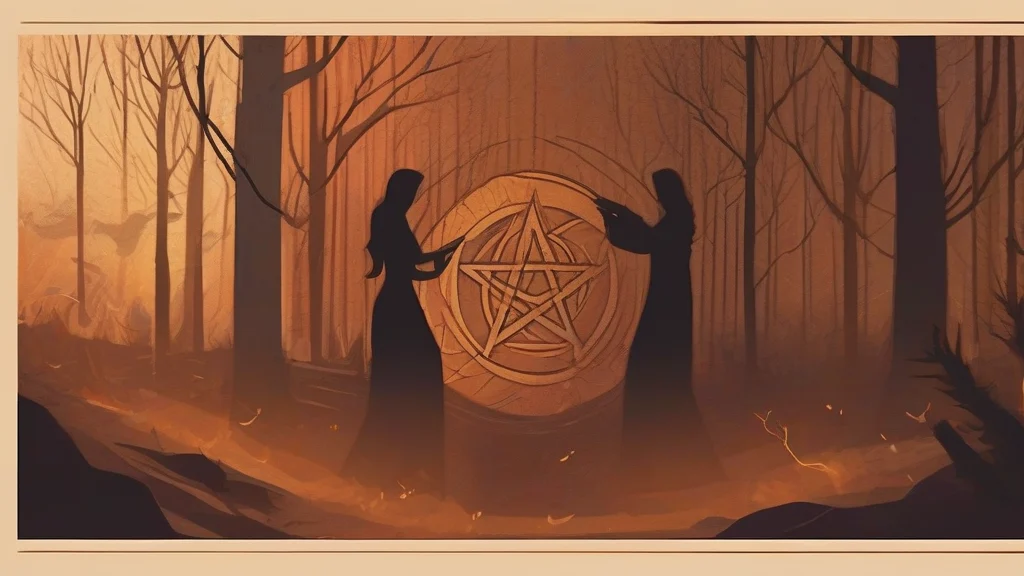
What does wicca mean?
Wicca is a modern Pagan religion that combines ideas of pre-Christian European nature worship with modern forms of witchcraft. It developed in Britain and is now followed in many countries, with practices that often include seasonal rituals, meditation, astrology, and respect for natural places. The word names the religion or tradition rather than an individual practitioner; “a Wiccan” and “Wiccans” are used for adherents. Wicca often carries connotations of nature spirituality, feminist or ecological values, and a deliberately chosen Pagan identity, but no single practice or worldview defines it. Unlike “witchcraft,” which can describe historical or fictional magical practices generally, Wicca denotes a particular modern religious current. It should not be assumed to preserve a single authentic ancient Celtic religion; its modern practitioners combine historical sources with reconstruction and imaginative elements. For readers, Wicca is useful because it distinguishes a specific contemporary Pagan tradition from the broader labels “witchcraft” and “paganism.”
nounWicca is a modern Pagan religion that draws on ideas of pre-Christian European nature worship and modern witchcraft, often incorporating Celtic, occult, and ecological influences.
- A modern Pagan religion and spiritual tradition emphasizing nature-based spirituality, witchcraft, seasonal ritual, and the recreation of pre-Christian European religious customs.
"The book examines the rituals and beliefs that have shaped modern Wiccan practice."
"She has studied Wiccan traditions and their relationship with ecology for many years."
"The novel draws on the history of witchcraft and modern Wiccan ritual."
The plural “wiccas” is grammatical when referring to multiple adherents, although “Wiccans” is the conventional and more natural form.
"Several Wiccans gathered at the coven to celebrate the equinox."
Wicca borrowed an Old English word for “witch,” yet the modern religion is followed by practitioners of any gender.
Reviewed by Deb Chak, Editor. AI-assisted content curated by RJS Tech Solutions LLP.
Etymology of wicca
In 20th-century Britain, the name was adopted for a revived form of Pagan spirituality. It was taken from Old English wicca, also represented by the closely related wicce, an old word for a witch or sorceress. Modern Wicca developed in Britain and subsequently spread internationally, while words such as witch, witchcraft, and witchery descend from the same older English vocabulary.
Related word forms
How wicca is actually used
Wicca is normally used as a mass noun for the religion or tradition. The related noun “Wiccan” denotes an adherent, while “Wiccan” is also the usual adjective. The term should not be treated as a synonym for all forms of witchcraft or assumed to preserve a single authentic ancient Celtic religion.
Easily confused with wicca
Witchcraft is the broader term for magical practices, whereas Wicca names a particular modern Pagan religion and spiritual tradition.