
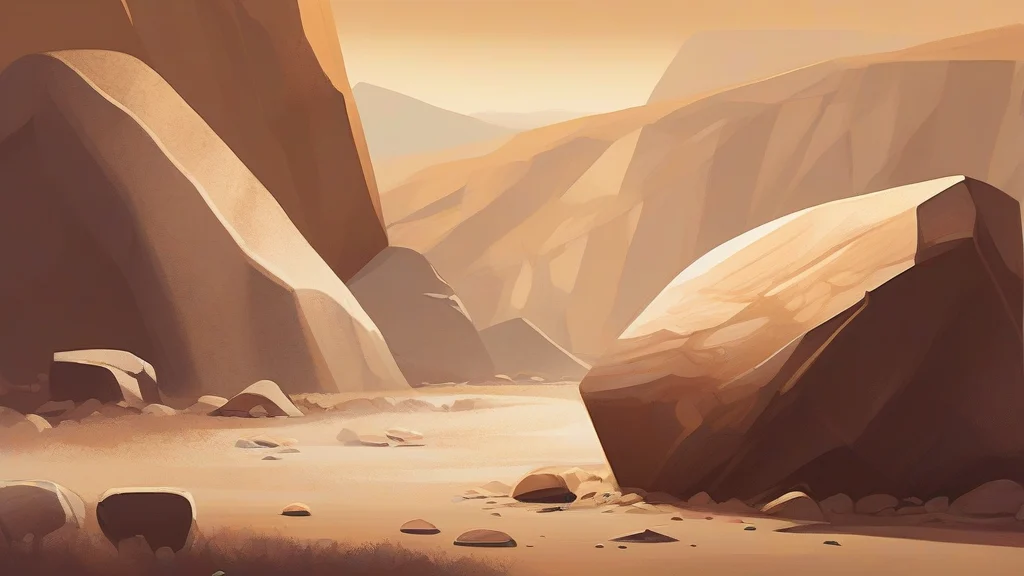
What does boulder mean?
A boulder is a very large, typically rounded piece of rock — large enough that it cannot easily be moved by hand, and often worn smooth over time by water, wind, or the slow grinding passage of glaciers. In everyday language, the term covers any impressively big rock you might encounter while hiking or driving through mountainous terrain. In geology, however, "boulder" carries a precise technical meaning: on the widely used Wentworth scale, it refers to rock fragments larger than about ten inches (roughly 256 millimeters) in diameter, placing them above cobbles and below the scale's upper limits. Boulders have particular significance in the study of past climates, since glaciers can transport them great distances, leaving them stranded far from their origin; such "erratic" boulders helped early scientists prove that ice ages had occurred. The word also anchors the popular sport of bouldering, in which climbers ascend large rocks without ropes.
nounA large rounded rock, typically one that has been worn smooth by erosion or transported and deposited by glacial action. In geology, the term is technically restricted to rock fragments larger than about 25 centimeters (roughly 10 inches) in diameter.
- A large rounded mass of rock, especially one worn smooth or deposited by glacial action.
- (Geology) A rock fragment larger than 256 millimeters (about 10 inches) in diameter — the technical size threshold distinguishing boulders from cobbles.
"The hikers paused to rest on a massive boulder overlooking the valley."
"Glaciers carried enormous boulders hundreds of miles from their source and dropped them across the plain."
"She scrambled over wet boulders along the riverbank."
Standard pluralization; used freely when referring to multiple large rocks, as in landscapes, riverbeds, or climbing routes.
"The trail was littered with loose boulders dislodged by last winter's freeze-thaw cycles."
The word 'boulder' comes from a Scandinavian word meaning 'rounded stone' — and it's so tied to ice that geologists literally named an entire type of soil after it: 'boulder clay.'
Reviewed by Deb Chak, Editor. AI-assisted content curated by RJS Tech Solutions LLP.
Etymology of boulder
"Boulder" entered English in the early 17th century, borrowed from a Scandinavian source — most directly via Swedish "bullersten," meaning a noisy (or rounded) stone in a stream bed. It is related to the broader Germanic family of words around "bold" in its older sense of a rounded lump or stone, though the modern adjective "bold" (daring) developed separately. An older variant spelling, "bowlder," was common in 18th- and 19th-century English texts but has since fallen out of use. The word spread into geological terminology in the 19th century, giving rise to terms like "boulder clay," a deposit left behind by retreating glaciers.
Related word forms
How boulder is actually used
"Boulder" is used both as an everyday word for any very large rock and as a precise technical term in geology, where it denotes particles above roughly 10 inches (256 mm) in diameter on the U.S. Wentworth scale. In casual speech, people often apply it loosely to any big rock, whether smooth or angular. The related sport of climbing large rocks without ropes is called "bouldering."
Easily confused with boulder
"Boulder" is a large rock, while "bolder" is the comparative of the adjective "bold," meaning more daring or courageous.