
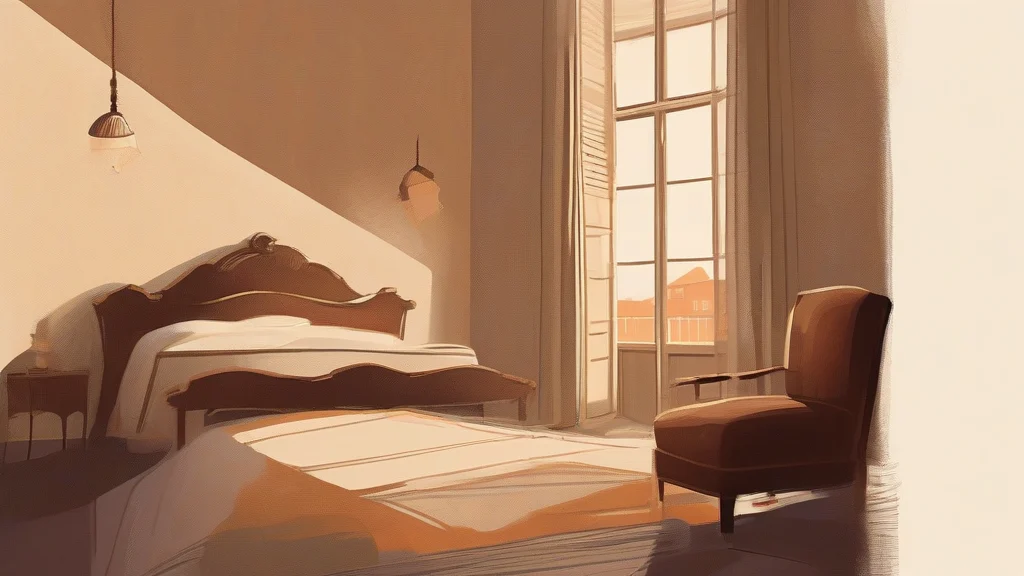
What does chambre mean?
"Chambre" is the French word for a room, most often a bedroom, and it enters English almost exclusively through set phrases borrowed from French. By far the commonest of these is "chambre d'hôte," literally "host's room," which denotes a small guesthouse or bed-and-breakfast and is widely understood by travelers to France. Because it is a foreign borrowing rather than a naturalized English word, "chambre" carries an air of continental elegance; writers sometimes deploy it deliberately to evoke French hotels, aristocratic apartments, or old-world refinement. In ordinary English prose, however, its native counterparts — "room" and "chamber" — do the same work. Indeed, "chamber" descends from the very same Old French source, so the two words are etymological siblings, one staying home and one remaining abroad.
nounA room, especially one of some elegance or formality; in English, the word is used chiefly in borrowed French expressions such as "chambre d'hôte" (a guest room or bed-and-breakfast).
- A room, particularly a bedroom or lodging, in French and in French phrases adopted into English.
- (Historical/rare) An anglicized spelling of chamber in older English texts.
"The innkeeper showed them to their chambre, its windows opening onto the vineyard."
"They stayed in a charming chambre d'hôte overlooking the Loire."
"The hotel brochure promised every chambre would have a view of the sea."
In French phrases the plural follows French form, e.g. "chambres d'hôtes."
"The village has several chambres d'hôtes for summer visitors."
Every time you book a chambre d'hôte in France, you're using a word that gave English both "chamber" and — via Latin's little vaulted rooms — "camera."
Reviewed by Deb Chak, Editor. AI-assisted content curated by RJS Tech Solutions LLP.
Etymology of chambre
"Chambre" comes from Late Latin "camera," meaning a vaulted room or chamber, itself from Greek "kamarā" (vaulted roof). It passed into Old French as "chambre," and Middle English borrowed it in that form before the word settled into its modern English shape as "chamber." Cognates include Spanish "cámara" and Italian "camera," which is also the source of English "camera" via "camera obscura."
How chambre is actually used
"Chambre" is not an ordinary English word; it belongs to the French language and survives in English mainly inside fixed borrowings like "chambre d'hôte." Using it on its own in an English sentence is literary or affected. The everyday English counterpart is "chamber" or simply "room."
Easily confused with chambre
"Chamber" is the standard English word for a room or enclosed space, while "chambre" is the French equivalent, used in English only within borrowed French phrases.