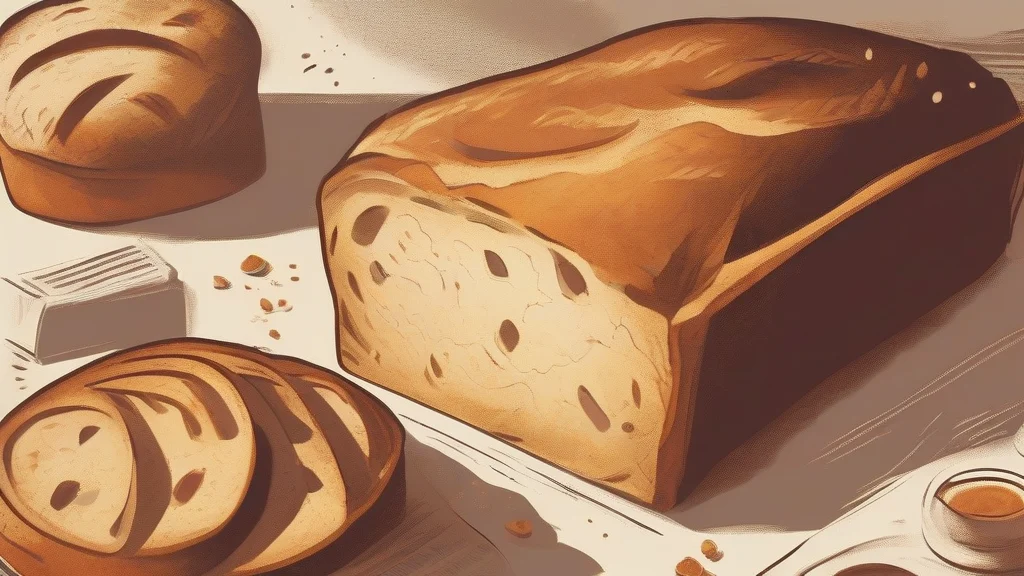
What does crust mean?
Crust refers to the firm outer layer that forms or encases something softer within. Its most familiar uses are culinary: the crisp exterior of a loaf of bread and the flaky shell of a pie are both called crusts. Beyond the kitchen, geologists use the word for the thin, solid outermost shell of rock that makes up the Earth's surface, and everyday speech applies it to any hardened film that develops over a liquid or soft material, such as ice on snow or dried mud on boots. Figuratively, "the upper crust" denotes society's wealthiest tier, an idiom that grew out of the practice of slicing the prized top from a loaf. Crust can also function as a verb meaning to form such a hard outer layer. Concretely useful and rich in metaphor, the word appears constantly in cooking, science, and idiom alike.
The hard, outermost layer of something, especially bread, pastry, or the Earth's surface.
"The baker scored the crust before sliding the loaf into the oven."
Frequently used in fixed phrases such as "bread crust," "pie crust," and "Earth's crust."
To form a hard outer layer on something, or to cover it with one.
"The mud crusted over as the sun dried the riverbank."
Often appears with "over" when describing a layer forming across a surface.
Standard English plural; used when referring to multiple pieces of crust or several distinct layers.
"The children left their crusts on the edge of every plate."
"Upper crust" began as literal bread — the top slice of a loaf — before becoming shorthand for high society.
Reviewed by Deb Chak, Editor. AI-assisted content curated by RJS Tech Solutions LLP.
Etymology of crust
Crust comes from Latin "crusta," meaning the rind or hard outer shell, which also gave rise to "crustacean" via the shared notion of a hard external covering. The word entered English in the medieval period, likely through Old French "crouste." Its use for the Earth's rocky outer layer developed much later, becoming standard in scientific vocabulary by the eighteenth and nineteenth centuries. Cognates appear across Romance languages, such as French "croûte" and Italian "crosta."
Related word forms
How crust is actually used
Commonly used both literally and figuratively; "upper crust" is an established idiom for the wealthy elite. In British English, refusing to eat bread crusts is traditionally associated with children's fussy eating.
Easily confused with crust
Crust is the hard outer layer of bread or of the Earth, while crux refers to the most important or decisive point of an issue.
Cusp is a pointed end where two curves meet, often used figuratively as in 'on the cusp of change,' whereas crust is a hard outer covering.