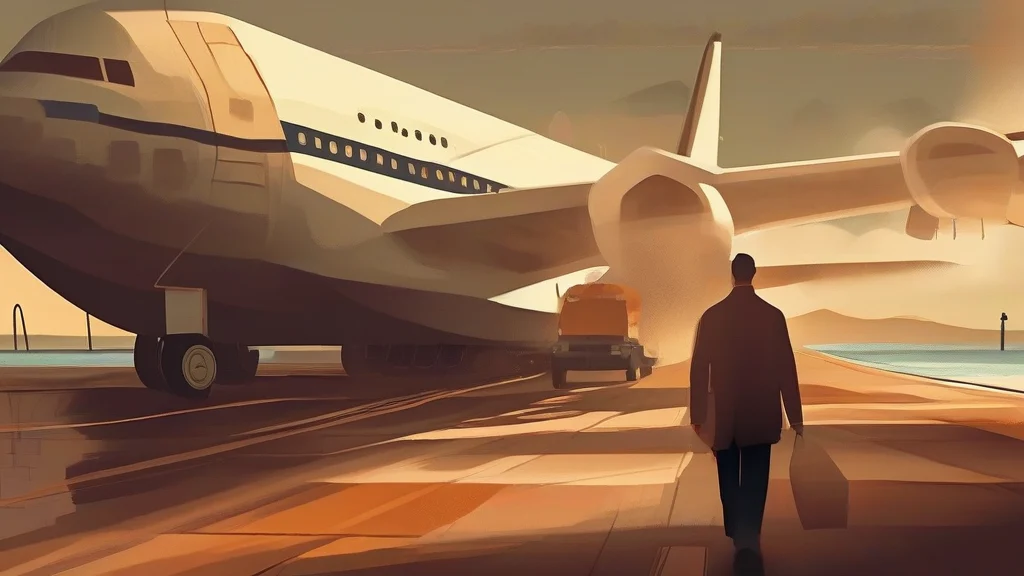
What does disembark mean?
To disembark is to leave a ship, aircraft, train, or other vehicle, especially at the end of a voyage or journey. The verb is most strongly associated with sea travel — passengers disembark when a ferry docks, troops disembark onto a beach — but modern usage extends comfortably to planes and trains. It carries a somewhat formal tone: airline crews announce that passengers may disembark, and news reports describe refugees disembarking from crowded boats, whereas casual conversation usually prefers 'get off.' Its opposite is embark, to board or begin a journey. The word derives ultimately from a Germanic root for 'boat,' borrowed through Old Norse and French into English, so its very sound preserves the maritime world in which it was coined. Because it appears constantly in travel writing, history, and immigration narratives, disembark is a useful word for anyone describing journeys with precision and dignity.
verbTo leave a ship, aircraft, or other vehicle, especially after a journey; to go ashore or step off from a vessel.
- To leave a ship or other vehicle after a journey, especially by going ashore.
"Passengers began to disembark as soon as the ferry docked at the terminal."
"After a two-week crossing, the immigrants finally disembarked at Ellis Island."
"Troops were instructed to disembark quickly and assemble on the quay."
The word literally means to 'leave the boat' — and its cousin 'embark' still carries that boat inside it, via the same French root.
Reviewed by Deb Chak, Editor. AI-assisted content curated by RJS Tech Solutions LLP.
Etymology of disembark
Disembark comes from the prefix dis- ('away, apart') combined with embark, which entered English in the 16th century from French embarquer. The French verb traces further back through Medieval Latin barca ('boat'), itself borrowed from a Germanic source — likely related to Old Norse barki — making the word's deepest root a Germanic term for a small ship. Cognates sharing this lineage include embark itself and barque, a poetic term for a sailing vessel. Disembark has been used in English since at least the early 17th century.
How disembark is actually used
Formal to neutral register; common in travel, military, and immigration contexts. In everyday speech people more often say 'get off' (a bus, plane, etc.), reserving 'disembark' for ships and official announcements.
Easily confused with disembark
"Debark" is a synonym of "disembark" meaning to leave a vehicle, but it also means to strip bark from a tree; the two are unrelated in that second sense.