
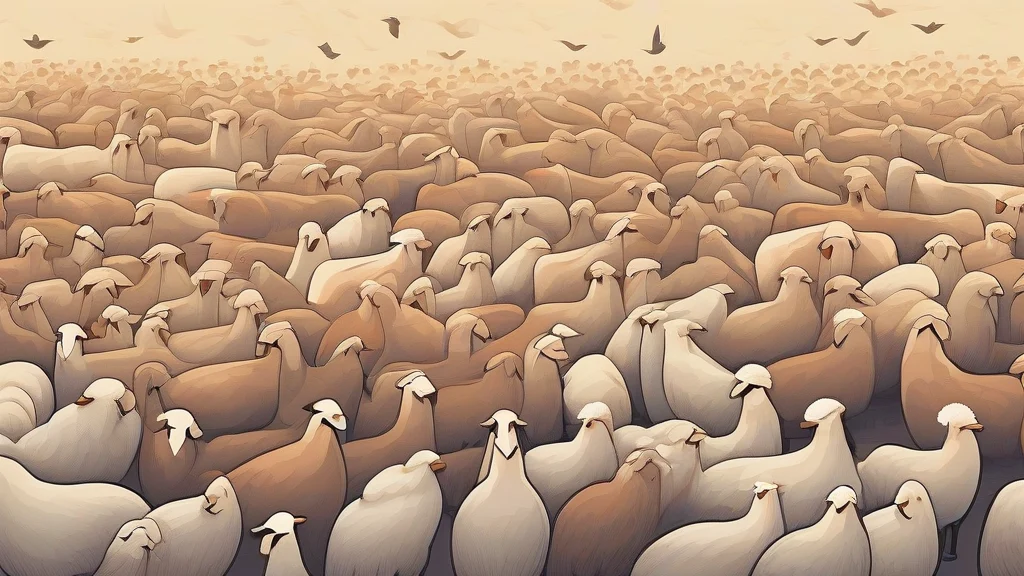
What does flock mean?
A flock is, most familiarly, a gathering of birds or sheep — animals that move, feed, and travel collectively. By extension, the word describes crowds of people who converge on a place or event, as in 'shoppers flock to the sales'. It also functions as a verb: to flock somewhere is to gather or arrive en masse, a usage that emphasizes spontaneous collective behavior rather than organized assembly. A second, older strand of the word refers to a tuft of wool or cotton fiber, surviving in trades such as upholstery and in 'flocked' wallpaper or fabrics with a soft raised texture. Socially, flock carries warm, pastoral connotations — a congregation guided by a shepherd, literal or spiritual — which is why phrases like 'birds of a feather flock together' endure. Simple, ancient, and vivid, it remains one of the most natural ways English expresses the instinct to gather.
A number of birds, sheep, or other animals gathered, living, or moving together; by extension, a large crowd of people.
"A flock of geese descended on the frozen lake at dawn."
Used chiefly of birds and sheep; 'herd' covers cattle, 'pack' covers carnivores such as wolves.
To gather or move in a crowd or group, typically toward a particular place.
"Fans began to flock to the stadium hours before kickoff."
A tuft or mass of wool, cotton, or waste fibers, especially finely ground fibers applied to surfaces or used as stuffing.
"The upholsterer padded the chair with flock before covering it."
Mainly technical or commercial today, appearing in trades such as textiles, wallpaper, and model-making.
The regular plural; often used broadly, as in 'birds gathering in flocks'.
"In autumn, flocks of migrating waders settle along the mudflats."
Flock has two separate ancestors: the birds-and-sheep 'flock' comes from Old English, while woolly 'flock' descends from Latin floccus — making 'floccinaucinihilipilification', famously the longest word in major English dictionaries, a distant cousin of the sheep in the field.
Reviewed by Deb Chak, Editor. AI-assisted content curated by RJS Tech Solutions LLP.
Etymology of flock
The main noun comes from Old English 'flocc', meaning a band or company of people or animals, and has been used for groups of birds since early times; its ultimate origin within the Germanic languages is uncertain. The verb developed naturally from the noun in Middle English. A distinct word 'flock', meaning a tuft of wool, entered Middle English from Old French 'floc', itself from Latin 'floccus' — the same root that gives us 'flocculent' and the tongue-twisting 'floccinaucinihilipilification'.
Related word forms
How flock is actually used
'Herd' is preferred for cattle and large mammals, 'pack' for wolves and dogs, and 'flock' specifically for birds and sheep; the figurative use for people ('the faithful flock') carries a mildly pastoral, communal tone rather than a critical one.
Easily confused with flock
A fleck is a small speck or flake of something, while a flock is a group of animals or people (or a tuft of wool); they look and sound similar but mean entirely different things.