
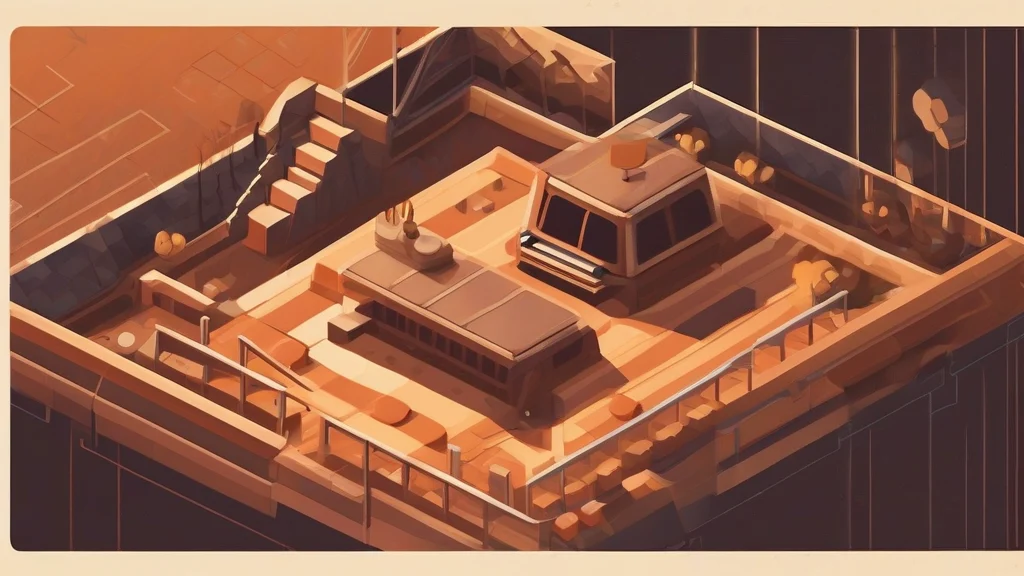
What does isometric mean?
Isometric is an adjective meaning equal in dimension or measurement, or concerned with equal measurement. Its best-known use is in geometry and technical drawing: an isometric projection represents three-dimensional objects on a flat surface using axes that remain equally spaced, producing the familiar angled appearance of diagrams and illustrations. In physical exercise, an isometric contraction occurs when a muscle produces tension without changing length, as when a person holds a weight still rather than moving it. The word therefore suggests balance, equal scale, and unchanged measurement. Although it is more common in technical and educational contexts than in ordinary speech, it remains useful in describing both systems of representation and controlled muscular effort. Related terms include isometry, the mathematical relationship between equal corresponding measurements, and isometrically, the adverb form commonly used in descriptions of drawings and exercises.
Having equal dimensions or measurements; relating to a form of projection in which objects are represented by axes of equal scale at fixed angles.
"The diagram is an isometric representation of the machine’s main components."
Chiefly used in geometry, engineering, drafting, and technical illustration.
Denoting muscular contraction in which tension changes without a corresponding change in muscle length.
"An isometric wall sit is often used as a strengthening exercise."
Common in exercise science, physiotherapy, and physical education.
Isometric literally means “equal measure,” a fitting description of a technique that represents three dimensions using equally scaled lines.
Reviewed by Deb Chak, Editor. AI-assisted content curated by RJS Tech Solutions LLP.
Etymology of isometric
Isometric was formed in the early 19th century from Greek iso, meaning “equal,” and metron, meaning “measure.” The same combination had already produced isometry, a noun denoting equality of measure, especially between corresponding parts or figures. The prefix iso-, from the Greek for “equal,” also appears in many later scientific words, including isothermal, isotonic, and isobaric. In modern English, isometric developed especially in geometry and later in physiology and physical education.
Related word forms
How isometric is actually used
The term is chiefly technical in geometry, engineering, and exercise physiology. In general writing, it is most often encountered in “isometric projection” and “isometric exercise.”
Easily confused with isometric
An isometric contraction changes muscle tension without changing muscle length, whereas an isotonic contraction occurs while the muscle changes length.