
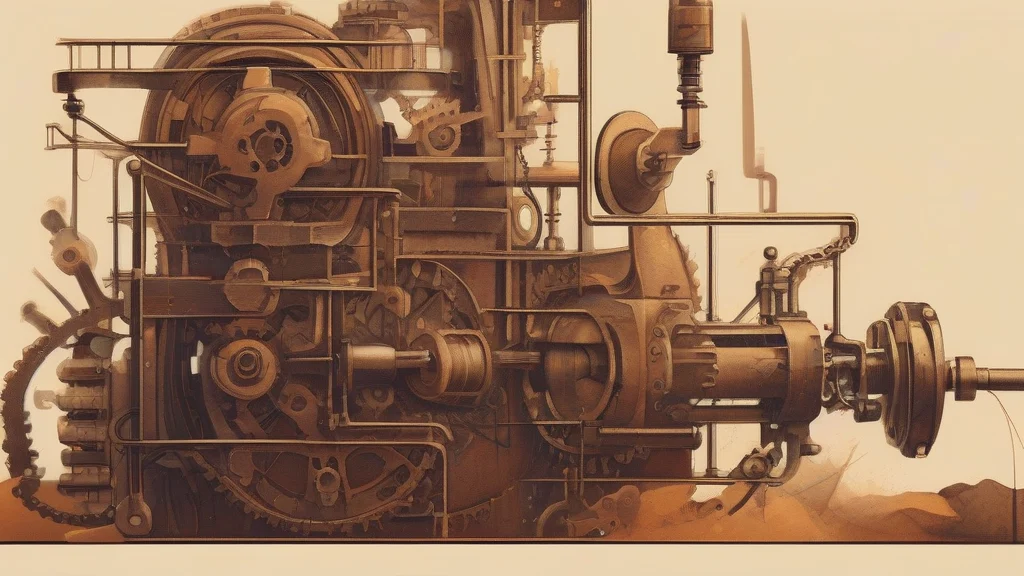
What does mechanism mean?
Mechanism is a formal word for the process, arrangement, or system by which something happens or operates. It can refer to a chain of actions in an institution, the working parts of a device, or a scientific account of how a phenomenon occurs. In everyday discussion, “the mechanism behind the decision” usually means the forces or steps that produced it. In biology and related sciences, “the mechanism of evolution” means the processes that produce evolutionary change, while in engineering a mechanism is an assembly of moving parts that transmits or modifies motion or force. The word often suggests an identifiable, interlocking system rather than a chance occurrence. It is usually more formal and technical than “way,” “process,” or “method,” and a mechanism may be physical, biological, institutional, or explanatory. Because the term can describe both a thing and the way it works, it is useful when discussing causation, design, and the hidden structures behind observable outcomes.
nounA process, system, or arrangement by which something happens or operates; also, a device or system of parts that performs a particular function. In technical contexts, the term can mean a proposed explanation of how a phenomenon occurs.
- A process, system, or sequence of actions by which a result is produced.
- A device or arrangement of parts that performs a function, especially by transmitting or modifying motion or force.
- A scientific or explanatory account of the processes underlying a phenomenon.
"The mechanism behind the proposal is designed to reduce delays while preserving public oversight."
"Researchers proposed a mechanism that explains how the protein changes shape."
"The mechanism behind the new payment system is a combination of automated checks and manual review."
The plural is used for distinct processes, systems, devices, or explanatory models.
"The researchers compared several mechanisms of plant growth under changing light conditions."
From the Greek mēchanē, meaning “machine,” mechanism literally describes the hidden machinery that makes an outcome happen.
Reviewed by Deb Chak, Editor. AI-assisted content curated by RJS Tech Solutions LLP.
Etymology of mechanism
The word derives from the Greek mēchanē, meaning “machine” or “device,” together with a suffix indicating a process or mode of action. It entered English through learned Latin and French forms in the early modern period. The same Greek root underlies words such as mechanic, mechanical, mechanics, and mechanize, reflecting the shared sense of machines, tools, and ways of working.
How mechanism is actually used
Generally formal and technical, though it is common in general discussion of organizations, government, science, and design. It often implies an identifiable system of interacting parts or stages, and is usually countable.
Easily confused with mechanism
A machine is a physical device or apparatus, whereas a mechanism may be a physical assembly or, more broadly, the process or system that makes something happen.