
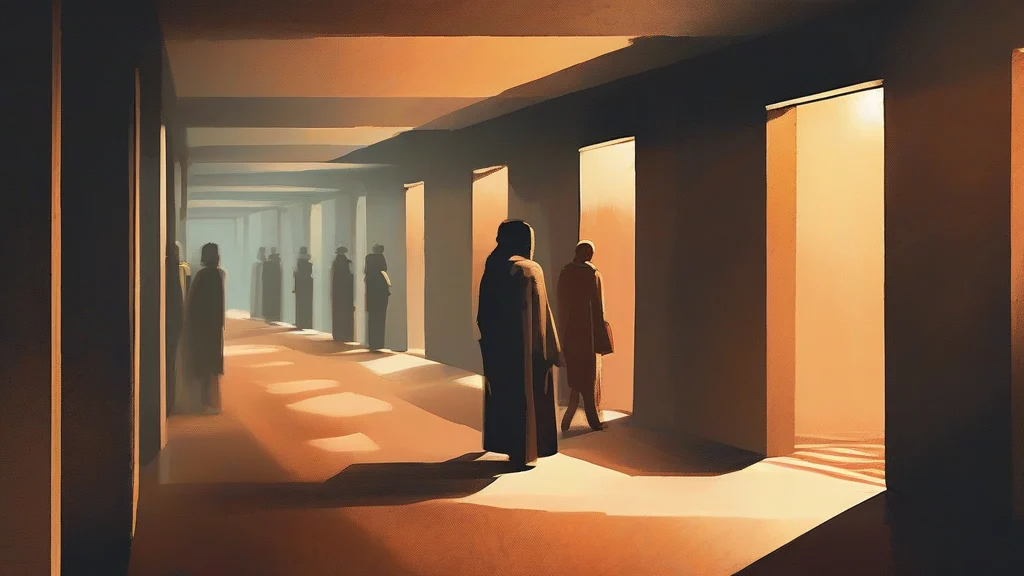
What does passage mean?
Passage most commonly means a section of a book, speech, or other written or spoken work. It can also refer to a route or way through a building or landscape, as in a narrow passage through a cave. Less literally, the word describes movement from one place, condition, or stage to another: ‘the passage of time’ means the process by which time passes, while a person’s ‘passage into adulthood’ marks an important transition. The word can also indicate permission or a means of proceeding, especially in expressions such as ‘safe passage’. In a legal or political context, ‘passage’ may mean approval or movement through an official process, as in the passage of a bill. Although passage can function as a verb in older usage, it is now principally a noun. Its usefulness lies in its ability to connect physical movement, textual sections, journeys, and abstract change.
A section of a book, speech, or other written or spoken work; a route through a place; or the act or process of passing from one place, person, condition, or time to another.
"The guide led them through a narrow passage between the cliffs."
The noun is far more common than the verb. Its sense as a section of a text is especially frequent in literary and educational contexts.
To pass or move; to make a way through.
"The vessel passages through the narrow strait."
This use is rare and chiefly literary or archaic.
The plural is passages, as in plural sections of a text or multiple routes through a place.
"Several passages in the novel echo the themes of the opening chapter."
One word can send you through a corridor, a chapter, or the passing of time: ‘passage’ turns movement into meaning.
Reviewed by Deb Chak, Editor. AI-assisted content curated by RJS Tech Solutions LLP.
Where does passage come from?
The word passage comes through Old French passage from Latin passagium, a noun formed from passare, ‘to pass’ or ‘tread’. Latin passare is generally connected with pandere, ‘to spread out’ or ‘tread’, the source of English pass and related words. The noun entered medieval English and eventually developed its familiar sense for a section of a text as well as its meanings involving routes, journeys, and the act of passing.
How passage is actually used
The word is broadly neutral, but some combinations, especially ‘the passage of time’ and ‘the passage of legislation’, have a formal or legal register. In literary contexts, ‘passage’ often refers specifically to a self-contained section of a text rather than merely any sentence or excerpt.