
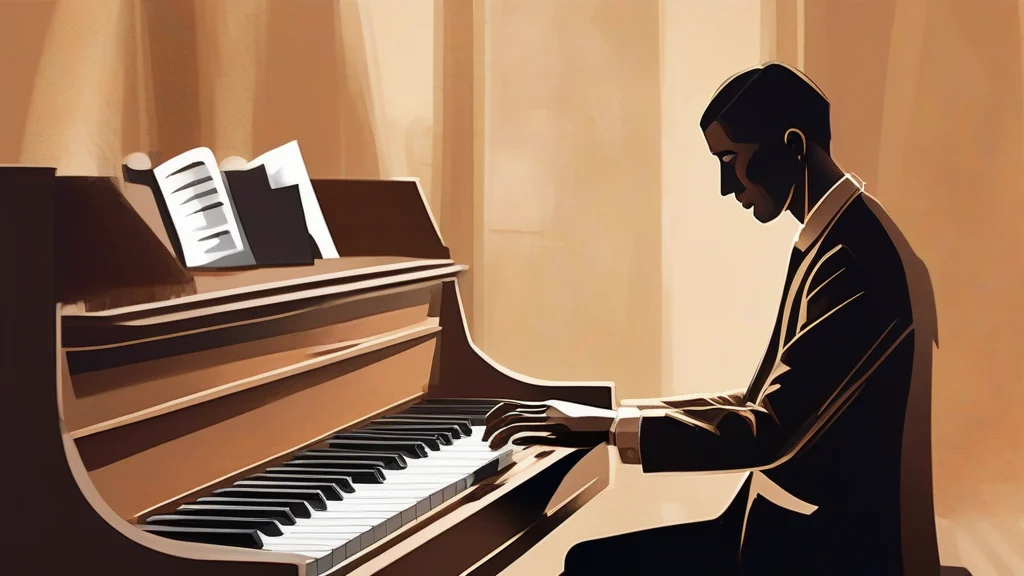
What does pianist mean?
A pianist is someone who plays the piano, especially a trained musician who performs publicly or professionally. The word is commonly used in phrases such as “concert pianist,” “jazz pianist,” and “classical pianist,” reflecting the instrument's range across classical, popular, and improvisational music. A pianist may be a soloist, accompany singers or other instrumentalists, or perform as part of an ensemble. Although the term can apply to anyone who plays the piano, it most often carries the practical implication of musical training and regular performance. In everyday speech, “piano player” may be used as a less formal alternative, while “keyboardist” can refer more broadly to someone who plays several keyboard instruments. The word ultimately comes through French from the Italian designation for the instrument, whose full name pianoforte reflects its ability to produce both soft and loud tones.
nounA pianist is a person who plays the piano, especially one who does so professionally or as a serious musician.
- A person who plays the piano.
- A musician who performs on the piano professionally or as an entertainer.
"The pianist began the concert with a quiet piece by Debussy."
"She is the pianist for a small jazz ensemble."
"The young pianist received enthusiastic applause after his recital."
The plural is used for two or more people who play the piano.
"The pianists met to discuss their concert repertoire."
A pianist may spend years learning one instrument, yet a single performance can make a concert hall fall silent.
Reviewed by Deb Chak, Editor. AI-assisted content curated by RJS Tech Solutions LLP.
Where does pianist come from?
The word pianist derives from French pianiste, which was formed from piano. Piano itself comes from the Italian term for the instrument, a shortened form of pianoforte, meaning “soft-loud.” The French suffix -iste was used to denote a professional or skilled practitioner, and English adopted the form in the 19th century. The same musical root appears in pianissimo and pianoforte, as well as in the related English terms pianist and piano.
Related word forms
How pianist is actually used
The term is neutral in register and can refer to performers of any level, although it often suggests trained or professional musicianship. In British usage, pianist is pronounced with an initial sound close to “pee-,” while the related word piano has the same initial consonant followed by a different vowel pattern.
Easily confused with pianist
A pianist is a person who plays the piano, whereas pianology is the scholarly study of the piano and its history.