
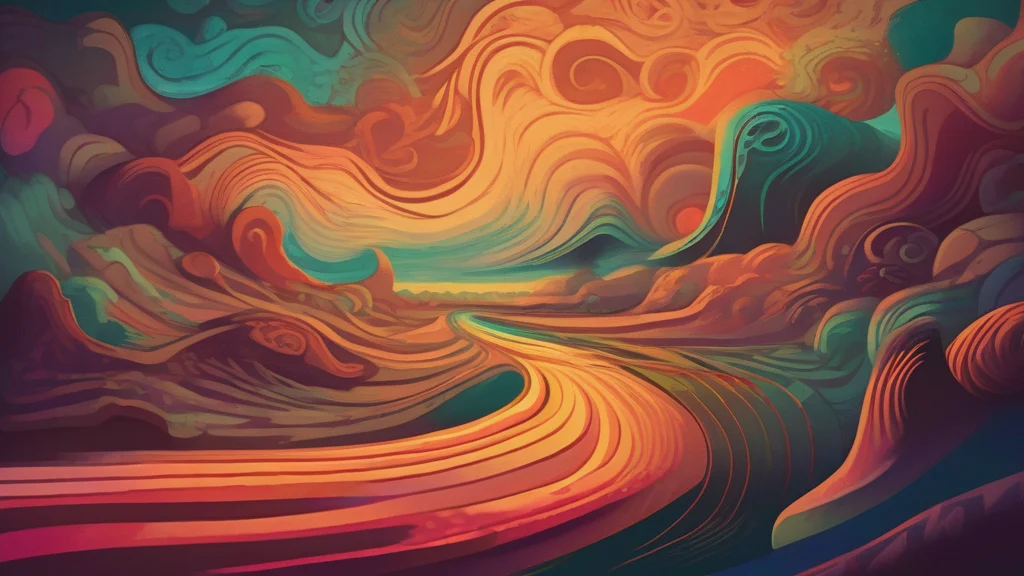
What does psychedelia mean?
Psychedelia is a noun describing altered states of perception and the cultural expression associated with them, especially music, art, and ideas connected with hallucinogenic experiences. The term commonly evokes the 1960s counterculture, psychedelic rock, poster art, and the practice of exploring consciousness through unusual sensory effects, although it is also used in contemporary discussions of art, music, psychology, and psychedelic research. As a mass noun, it usually describes a phenomenon or movement rather than a single experience. In phrases such as “psychedelic music” and “psychedelic drugs,” it functions more like a descriptive category than an independently countable thing. The word is related to “psychedelic,” the adjective and noun describing related experiences or substances, and derives from Greek roots associated with the soul, manifestation, and delirium.
nounPsychedelia refers to altered states of perception and related cultural practices associated chiefly with psychedelic experiences, especially those involving visual and sensory distortions. The term is also used for music, art, and other cultural expressions inspired by these experiences.
- The state or quality of being psychedelic, especially in relation to altered perception, sensory distortion, and the effects of certain psychoactive substances.
- The cultural, musical, and artistic movement associated with psychedelic experiences and countercultural themes.
- Psychedelic experiences collectively, particularly in discussion of music, art, and popular culture.
"The band helped popularize psychedelia with its experimental recordings and elaborate light shows."
"The exhibition explores psychedelia through immersive light, sound, and projected artwork."
"She wrote about the role of psychedelia in popular music during the late 1960s."
Psychedelia normally names a phenomenon, body of experiences, or cultural movement rather than countable individual items.
"The book examines psychedelia in music, literature, and visual art."
Psychedelia is both a name for altered perception and for the music and art that grew from the counterculture of the 1960s.
Reviewed by Deb Chak, Editor. AI-assisted content curated by RJS Tech Solutions LLP.
Etymology of psychedelia
The word is a borrowing formed from the English adjective “psychedelic” and the suffix “-ia.” “Psychedelic” comes from Greek psychē, meaning “soul” or “mind,” and dēlos, meaning “visible” or “manifest,” together referring to the manifestation of the mind or soul. Its modern sense developed through the use of “psychedelic” for substances and experiences that produce heightened or altered perception, before “psychedelia” came to name the associated culture and artistic movement.
Related word forms
How psychedelia is actually used
The word is most common in discussions of music, art, culture, and psychoactive substances. It is often associated with the 1960s counterculture but can refer to contemporary psychedelic art, research, and experiences.
Easily confused with psychedelia
Psychosis is a clinical condition that can involve hallucinations, delusions, and impaired thinking, whereas psychedelia usually refers to altered perception and the cultural tradition associated with it.
A hallucination is a perceptual experience, often involving sight or sound, while psychedelia is the broader phenomenon or cultural movement associated with such altered experiences.