
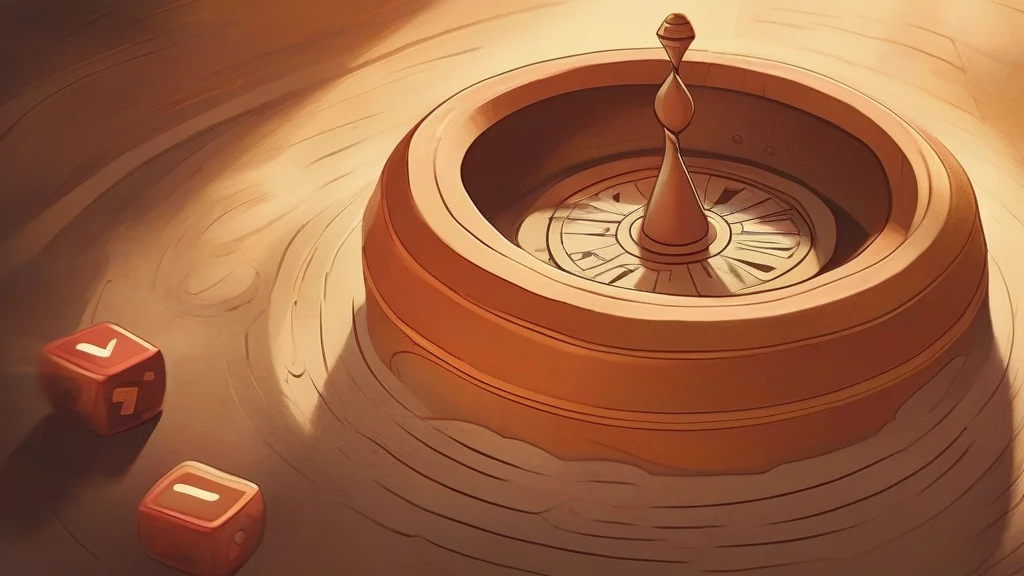
What does teetotum mean?
A teetotum is a small spinning top used in games, particularly to decide who plays first, which participant wins, or how stakes are divided. Such tops commonly have four sides or points of different lengths, with the result determined by which side comes to rest uppermost. The word can also denote the game played with this device. In modern writing, teetotum often carries a nostalgic or literary tone, evoking traditional children's games, old gambling customs, and decisions settled by chance. Although simple dice have largely replaced it in everyday play, the teetotum remains a vivid example of an object whose mechanics and appearance are inseparable from its purpose. The term can also be used figuratively for an unpredictable contest or selection. Its unusual form reflects its history: the word comes through French from Latin words meaning “all” or “the whole,” an association connected with the idea that a single spinning object could determine an entire outcome.
nounA teetotum is a small, usually four-sided top used in games, especially one spun to determine the order of play, the choice of player, or the allocation of stakes. The word can also refer to the game or activity of playing with such a top.
- A small top, commonly with four sides or points of unequal length, used in games and spun to determine an outcome.
- A game or game-like activity played with such a spinning top.
"The children spun the teetotum to decide who would begin the game."
"The teetotum landed on the winning number, and he claimed the last piece."
"In the old game, a teetotum was spun while the players wagered on which side would finish uppermost."
The standard plural adds the regular plural suffix -s.
"Several brightly painted teetotums lay on the table."
Spin the top, and chance chooses the player: that is the enduring charm of the teetotum.
Reviewed by Deb Chak, Editor. AI-assisted content curated by RJS Tech Solutions LLP.
Where does teetotum come from?
Teetotum entered English in the early nineteenth century from French té-totum, a form associated with the idea of “the whole” and ultimately Latin totum, the neuter singular of totus, meaning “all.” The compound developed from French elements meaning “all” and “whole,” fitting the use of a single top to determine the result of a game. Its relatives include total, totality, entire, and entirety, all of which ultimately derive from the same Latin root.
How teetotum is actually used
The word is literary and somewhat nostalgic today. It is especially common in descriptions of traditional children's games, gambling games, and historical contexts, as well as in figurative references to decisions made by chance.
Easily confused with teetotum
A teetotum is a spinning top used to determine the outcome or order of a game, whereas a totem is an object or emblem representing a clan, group, or ancestral lineage.