
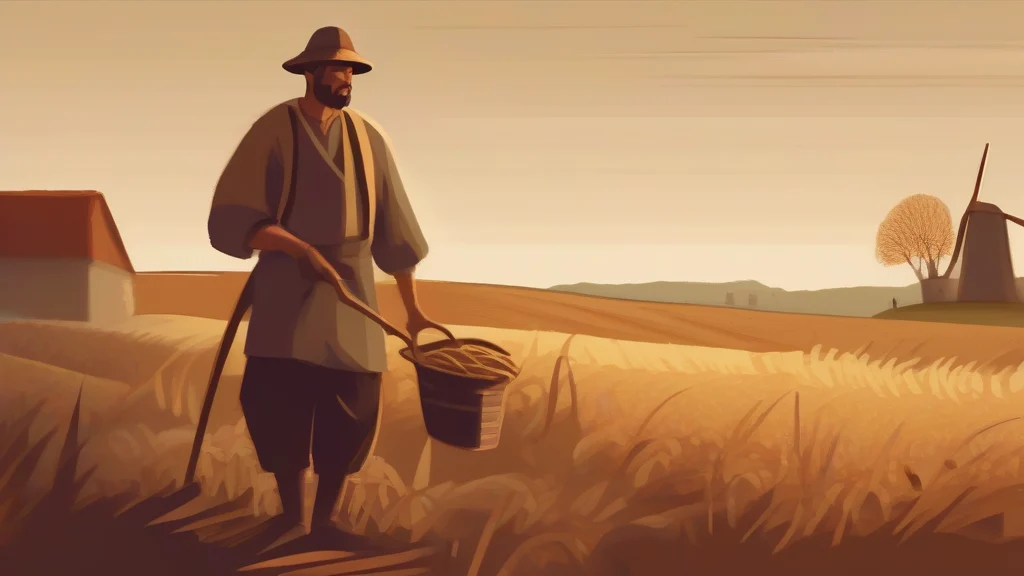
What does peasant mean?
A peasant is traditionally understood as a member of the rural agricultural population, such as a farmer, tenant, or agricultural labourer, especially one with modest means. The word has a long history in discussions of landholding, rural economies, and social class, and it remains useful for describing historical communities whose legal or economic status differed sharply from that of landowners and aristocrats. Its contemporary use requires care: it may be appropriate when discussing an occupational or historical group, but applying it directly to a person can sound insulting and imply rudeness, ignorance, or a lack of sophistication. In such contexts, a more specific term such as “smallholder,” “tenant farmer,” or “rural worker” is usually preferable. The related collective noun “peasantry” refers to peasants considered as a social group.
nounA member of the rural agricultural population, especially one who works a smallholding or farm and has relatively low social or economic status. Historically, the term referred broadly to a rural inhabitant or agricultural worker and is now sometimes considered derogatory.
- A rural agricultural worker or member of the rural population, especially one of comparatively low social or economic status.
- A person regarded as rustic, uneducated, or unsophisticated, now usually in an offensive or derogatory sense.
"The tenant farmers faced hardship during a period of poor harvests and rising taxes."
"The museum documents the lives of peasant farmers in the region during the eighteenth century."
"Using the word for an unfamiliar colleague came across as condescending and inappropriate."
Use the plural when referring to members of the rural agricultural population collectively or to several such people.
"Many peasants in the region owned their land and produced food for nearby markets."
The word once simply meant a person who lived in the countryside; its stronger social stigma and potential insult developed through later usage.
Reviewed by Deb Chak, Editor. AI-assisted content curated by RJS Tech Solutions LLP.
Etymology of peasant
Peasant comes through Old French paisant from Late Latin peasantem, an accusative form of peasantis. That form developed from the Latin adjective paganus, originally meaning “rural” or “of the countryside,” and associated with the larger Indo-European family of words represented by English “pagan.” The original sense of a rural inhabitant gradually acquired stronger social and economic connotations as agrarian populations came to be contrasted with landowners and urban elites.
Related word forms
How peasant is actually used
The term is neutral when used in historical, economic, or sociological contexts, but it can sound disparaging when applied to a particular person. In contemporary speech, “rural resident,” “smallholder,” or “agricultural worker” may be more appropriate depending on the intended sense.